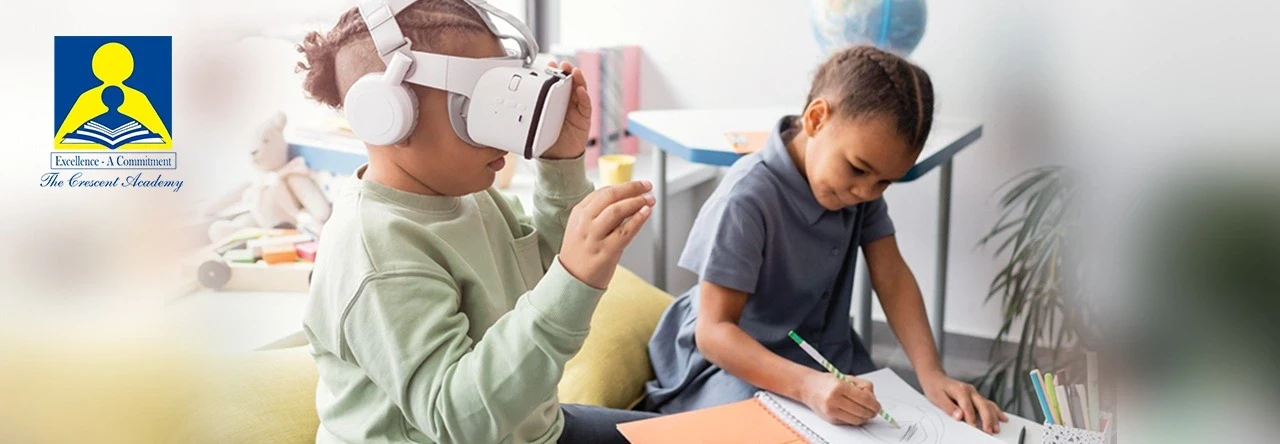
The way children learn is changing faster than at any point in the last century. Across classrooms in Karachi, Lahore, and Islamabad, a quiet revolution is underway, one powered not by textbooks or chalk, but by artificial intelligence. For parents navigating school choices in 2025 and beyond, understanding what AI means for your child's education is no longer optional. It is essential.
This guide breaks down exactly what is happening, what is genuinely beneficial, what concerns are worth taking seriously, and how forward-thinking schools in Pakistan, including here in Karachi, are preparing students for the world that awaits them.
What Is AI in Education, and Why Does It Matter for Pakistani Families?
Artificial intelligence in education refers to the use of intelligent software systems that can personalise learning, automate assessments, support teachers in lesson planning, and analyse student performance data in real time. Think of it as having a teaching assistant that never sleeps, one that can identify exactly where your child is struggling in mathematics and serve them the right practice problem at precisely the right moment.
This is not a distant, futuristic concept. It is already happening in Pakistan's leading private institutions. AI-powered tutoring platforms and intelligent lesson-planning tools are actively being used to support educators across the country. At the same time, the Federal Cabinet's endorsement of Pakistan's National Artificial Intelligence Policy 2025 signals that AI in education is now a national priority, not just a trend in elite schools.
For parents considering where to enrol their children, the question is no longer whether a school uses technology. The question is whether it uses technology intelligently.
5 Ways AI Is Already Changing How Children Learn in Pakistan
1. Personalised Learning: Every Child Gets Their Own Pace
One of the most significant advantages AI brings to the classroom is the ability to personalise education at scale. In a traditional classroom of 30 students, a teacher must pitch lessons at the average learner, which means the faster students are under-challenged, and the slower ones fall further behind.
AI-powered adaptive learning platforms change this entirely. They track each student's responses, identify misconceptions in real time, and adjust the difficulty of exercises accordingly. Research has shown that AI-assisted adaptive learning tools can deliver a 20–30% improvement in student engagement and retention compared to traditional teaching methods alone.
In Pakistan's private school sector, several institutions are already deploying such tools, and schools with low teacher-to-student ratios, like those operating at a 1:5 ratio, are particularly well-positioned to combine human mentorship with AI-driven personalisation for outstanding results.
2. Smarter Classrooms: Beyond the Blackboard
Walk into a leading private school in Karachi today, and you are unlikely to see a chalk-dusted blackboard. Smart interactive whiteboards, connected learning environments, and digital assessment platforms are becoming the norm. These are not mere substitutes for older tools; they fundamentally change how lessons are delivered.
When connected to AI systems, smart classroom technology can display real-time comprehension data to a teacher during a lesson. If twelve out of twenty-five students appear to be struggling with a concept, based on how they interact with a digital quiz mid-lesson, the teacher can pause, re-explain, and adapt, rather than pressing forward and discovering the gap only at exam time.
3. AI-Assisted Lesson Planning for Teachers
Pakistan has long grappled with a teacher quality gap, particularly outside major urban centres. AI is proving to be a powerful equaliser here. Tools like MagicSchool.ai and similar platforms are helping teachers create differentiated, high-quality lesson plans far more efficiently than before.
A landmark study conducted by EdTech Hub in Islamabad's public schools found that AI-powered lesson planning tools reduced teacher workload by 31% while maintaining and in many cases improving lesson quality. For private schools in Karachi, where teacher development is already a priority, AI tools amplify the impact of an already strong faculty, freeing educators to focus on the deeply human work of mentoring, motivating, and connecting with their students.
4. Fairer and Faster Assessment
Assessment in Pakistan's education system has traditionally been high-stakes and infrequent, a reality that places enormous pressure on students and gives teachers very little data to work with day to day. AI-driven assessment tools are beginning to change this by enabling low-stakes, continuous evaluation throughout the academic year.
Automated grading for objective assessments, AI-generated feedback on written work, and data dashboards that track a student's progress across subjects give parents and teachers a far richer picture of a child's learning journey. Rather than waiting for term results to discover that a student has a gap in algebraic reasoning, schools using AI can identify and address that gap weeks or months earlier.
5. Bridging the Access Gap: Cautiously
One of the most compelling arguments for AI in education is its potential to democratise access to quality learning. In a country where approximately 26 million children remain out of school, and rural schools frequently lack basic infrastructure, AI-powered mobile learning platforms offer the possibility of delivering quality education to students who would otherwise have no access to it.
UNESCO, in partnership with Pakistan's National Commission for UNESCO, ran a dedicated AI in education programme through late 2025, training teachers specifically in personalised learning tools and AI-powered tutoring. This kind of national investment signals a genuine commitment to using AI not just in elite institutions, but across the full spectrum of Pakistani education.
That said, parents should be aware that the benefits of AI remain unevenly distributed. Reports indicate that only 12–14% of rural government schools in Pakistan have reliable internet access, meaning that AI's transformative potential is, for now, most fully realised in well-resourced urban private schools. Choosing a school that has invested seriously in digital infrastructure is, therefore, one of the most important decisions Karachi parents can make.
What Parents Should Watch Out For
AI in education is powerful, but it is not without risks. As a parent, there are three concerns worth keeping at the front of mind.
Over-reliance on screens. AI tools are most effective when they supplement skilled human teaching, not replace it. Be wary of schools that position technology as a substitute for quality educators. The ideal environment blends AI-driven personalisation with strong teacher mentorship, a combination that schools with experienced, trained faculty and small class sizes are best placed to deliver.
Academic integrity. As AI writing and problem-solving tools become more accessible, the temptation for students to outsource their thinking grows. Leading schools are addressing this by designing assessments that require genuine reasoning, oral presentations, project-based learning, and tasks that demand critical thinking rather than mere information retrieval. Ask prospective schools how they are approaching this challenge.
Data privacy. AI systems collect significant amounts of data about your child's learning behaviour. Parents have every right to ask schools what data is collected, how it is stored, and who has access to it. Reputable institutions will have clear, transparent policies in place.
How Forward-Thinking Schools in Karachi Are Responding
The best schools in Karachi are not simply adopting AI because it is fashionable. They are integrating it purposefully, as one component of a holistic educational philosophy that prioritises critical thinking, character development, and real-world preparedness.
At The Crescent Academy, our approach to technology has always been rooted in our core belief: that the goal of education is not to fill a child with information, but to develop a confident, curious, and capable human being. Smart classroom technology, interactive learning environments, and data-informed teaching are tools in service of that mission, not replacements for the human relationships at the heart of every great school.
The Cambridge curriculum framework, which our students follow, is exceptionally well-suited to the AI era. It emphasises conceptual understanding, independent thinking, and problem-solving, precisely the skills that remain distinctly human and cannot be outsourced to any machine. When those skills are developed in classrooms enriched by thoughtful technology use, students are prepared not just for the next exam, but for a world of work that neither we nor they can fully predict.
Frequently Asked Questions
Q: Is my child's school supposed to be using AI already?
Leading private schools in Karachi are increasingly integrating AI-powered tools. However, quality matters more than quantity; ask schools not just whether they use AI, but how it supports individual student learning.
Q: Will AI replace teachers?
No. Research consistently shows that AI is most effective as a support tool for skilled teachers, not a replacement. The human elements of teaching, motivation, mentorship and emotional attunement remain irreplaceable.
Q: How can I tell if a school is using AI well?
Ask whether teachers receive ongoing training in educational technology. Look for evidence of personalised learning approaches, regular formative assessment, and a clear policy on student data privacy.
Q: What is Pakistan's National AI Policy 2025?
Endorsed by Pakistan's Federal Cabinet in July 2025, this is the country's first comprehensive roadmap for responsible AI development. It explicitly includes education as a key sector for AI-driven transformation.
Q: At what age should children start learning about AI?
Familiarity with digital tools and computational thinking can begin as early as primary school. However, the priority should always be on developing the critical thinking skills that allow children to use AI as a tool, rather than becoming dependent on it.
The Bottom Line for Karachi Parents
Artificial intelligence is not a threat to your child's education. Deployed thoughtfully, it is one of the most powerful tools available to help every child learn at their own pace, receive timely support, and develop the skills they need for a rapidly changing world.
What matters is not whether a school uses AI, but whether it uses it wisely, in service of teachers, students, and the fundamental goal of raising curious, capable, and confident young people.
If you would like to learn more about how The Crescent Academy integrates modern learning approaches with the Cambridge curriculum and Aga Khan values, we welcome you to visit our campus or get in touch with our admissions team.
Leave a comment